Explore Topics ▾
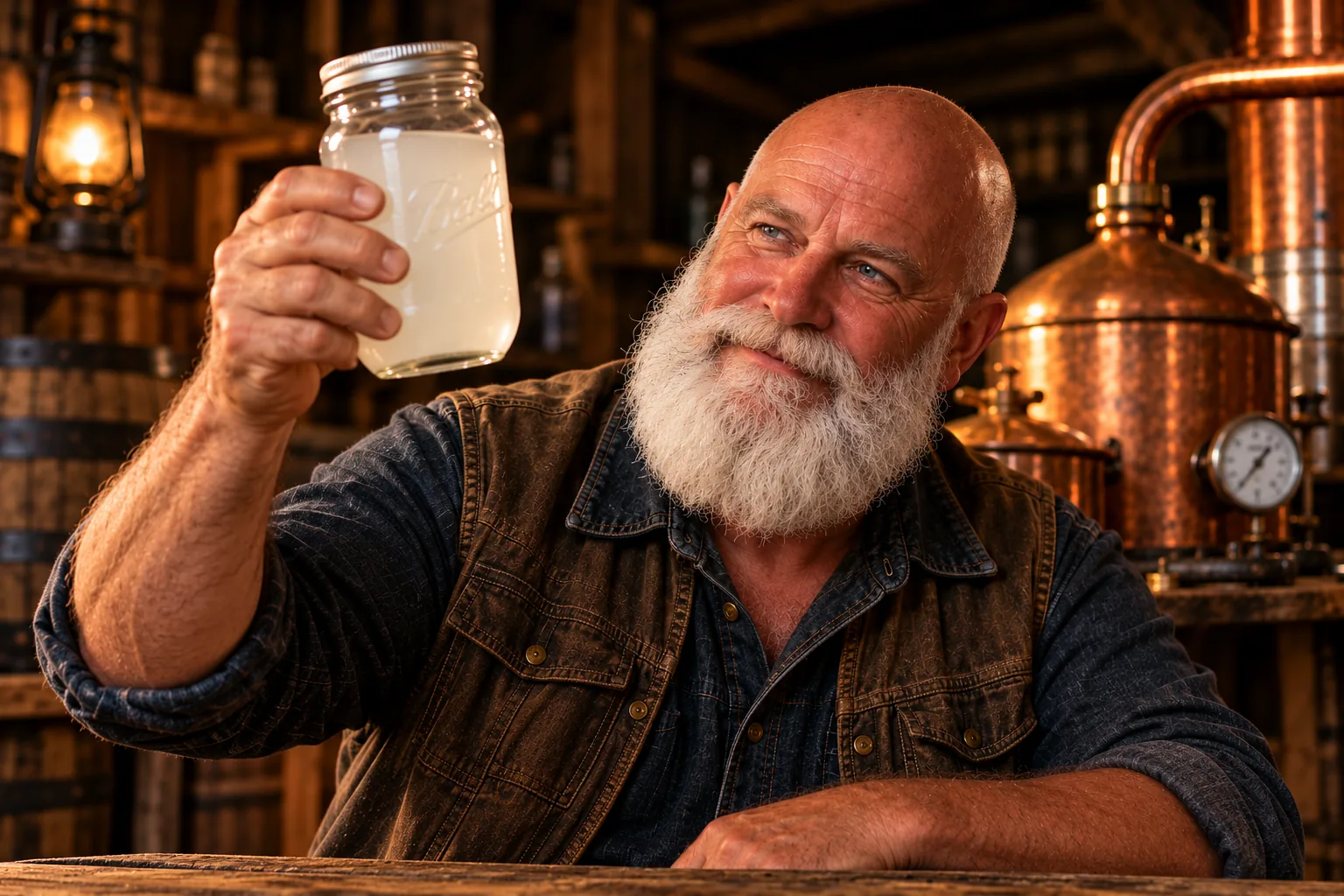
Why Is My Moonshine Cloudy?
What causes a milky haze in spirits, what it may mean, and why a clear jar doesn’t automatically mean a safe jar.
Did you clean your still before the run?
Leftover residue or contamination may affect what comes out. This quick check helps you decide where to start; a clean still alone does not establish that a spirit is safe.
Cloudy Moonshine: What Should You Check?
Find when the cloudiness started. These are clues to possible causes—not a test of whether homemade or unidentified alcohol is safe.
| What happened? | Your next step |
|---|---|
| Cloudy after adding water | Consider whether dilution brought oils out of solution or introduced minerals. Review the water source and ingredients. Don’t assume the batch is safe because the haze clears. |
| Cloudy only when cold | Chill haze may be responsible. A known commercial spirit may become clear again at room temperature; this is not a safety test for homemade spirits. |
| Cloudy after fruit or juice | Check whether pulp, pectin, or flavoring oils were introduced. If you notice spoilage or unexplained changes, do not drink it. |
| Cloudy during collection | Stop the run and set the collected liquid aside. Once equipment is safely shut down and cooled, check for residue, foaming or mash carryover, and equipment problems before any future use. Do not drink the affected batch. |
| Cloudy for an unknown reason | Label the batch DO NOT DRINK. Note when the change occurred and review ingredients, water, cleaning, and equipment condition. If the cause remains uncertain, do not consume it; household filtering or rerunning is not a reliable safety remedy. |
1. Natural Oils and the “Louche” Effect
Some flavor-bearing compounds dissolve more readily in a stronger alcohol-and-water mixture than in a weaker one. When water is added, tiny droplets can form and scatter light. The result can look cloudy or milky. This is often called louching , or the “ouzo effect,” and is especially noticeable in spirits containing botanical oils.
Whiskey can also develop haze from naturally occurring fatty-acid compounds. Haze of this type can affect appearance without necessarily indicating spoilage—but it does not establish that an unknown product is safe.
2. Temperature and Chill Haze
A spirit may look clear at room temperature but develop a haze when cooled or poured over ice. Cooling can reduce the solubility of certain compounds. Some commercial whiskies are chill-filtered to reduce this cosmetic effect.
3. Minerals and Dilution Water
Minerals or other substances in dilution water can sometimes affect clarity. Water-related haze is not necessarily the same as chill haze or oil-related louching.
4. Fruit, Juice, and Flavorings
Juice, fruit, spices, and flavorings can introduce oils, pulp, or other suspended material. These ingredients can change how a spirit looks, particularly after mixing or chilling.
5. Suspended Solids or Unexplained Contamination
Visible particles, unusual discoloration, unexpected residues, or changes in odor can have causes unrelated to natural spirit haze. A visual inspection cannot identify contaminants reliably. If the source or composition of a spirit is uncertain, do not taste it to investigate.
Old Traditions. Timeless Craft.
Explore whiskey history, traditional equipment, terminology, proof and ABV references, and illustrated field knowledge in Grandad’s Water of Life.
 Get the Digital Guide — $15.99
Illustrated PDF • Digital download
Frequently Asked Questions
Does cloudy moonshine mean it has methanol?
No. Cloudiness does not specifically indicate methanol, and a clear appearance cannot rule it out. Methanol is colorless. The safety of an unknown spirit cannot be established by looking at it.
Why does whiskey turn cloudy with ice?
Cold temperatures and dilution can reduce the solubility of naturally occurring compounds, sometimes creating a temporary haze. The exact effect varies with the spirit’s composition.
Does filtering cloudy spirits make them safe?
No. Removing visible haze or particles is not proof that chemical contaminants have been removed. Do not rely on household filtering as a safety treatment for an unknown spirit.
Is all cloudy whiskey defective?
No. Some properly produced commercial spirits develop cosmetic haze, particularly when diluted or chilled. But unexplained cloudiness in an unknown product still requires caution.
Sources and Further Reading
- ACS Omega — Temperature Dependence of Louche Formation in Absinthe
- Oxford Companion to Spirits & Cocktails — Louche
- CDC/NIOSH — Methanol Safety Information
- TTB — Distilled Spirits Proofing Tutorial
There’s More to the Story
Keep learning with Grandad’s illustrated guide to whiskey history, traditions, equipment, and field references.
Get the Complete Guide — $15.99