How to Clean a Copper or Stainless Steel Still
Know what to wash, when a heated cleaning run makes sense, and how to mix a compatible cleaning solution without guessing.
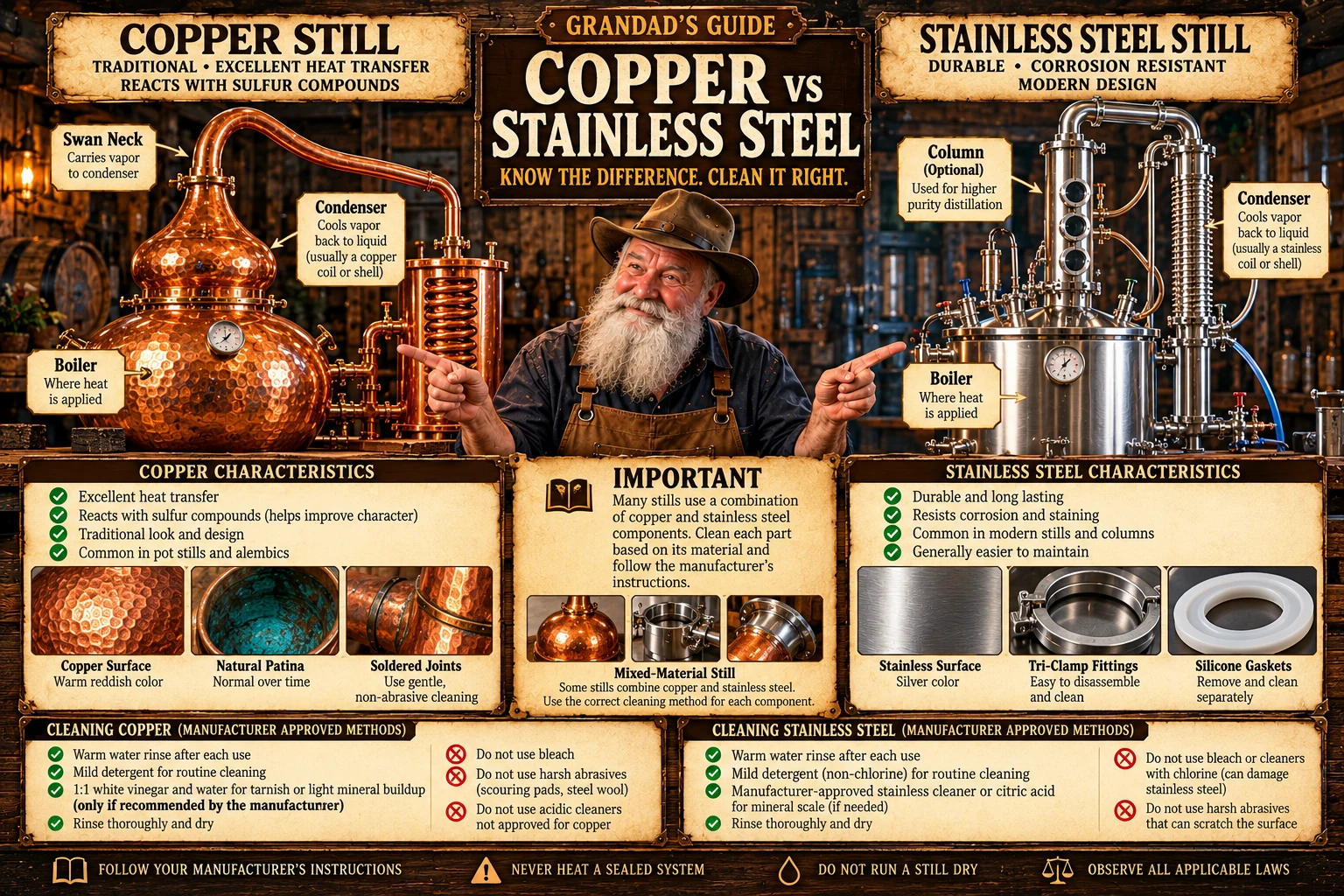
Learning how to clean a still starts with knowing whether your equipment is copper, stainless steel, or a combination of both. This guide explains routine cleaning, when a manufacturer-approved heated cleaning run may be appropriate, and how to calculate compatible vinegar-and-water mixtures.
Find the right cleaning approach
Choose your material, cleaning situation, and the amount of solution you actually need . The calculator below is for mixing a cold cleaning solution—not instructions to heat or fill a boiler.
Vinegar & water calculator
Some manufacturers specify a 1:1 mixture of plain white vinegar and water for compatible copper components. This calculator scales that mixture by the total solution volume you choose. It does not mean your still should be filled to that level.
Example: a 10-gallon still might need only a small quantity for wiping or soaking removable parts; a manufacturer-approved heated cleaning procedure may require a specific minimum fill. Boiler size alone cannot determine the correct cleaning volume. Always check the equipment manual.
Copper stills: step-by-step
- Cool, disconnect, and inspect. Allow the still to cool fully. Check copper surfaces, solder, gaskets, fittings, and manufacturer instructions.
- Wash visible residue. Use warm water, a soft cloth or nonabrasive brush, and a copper-compatible cleaner when recommended. Avoid steel wool and aggressive abrasives.
- Address tarnish selectively. For components whose manufacturer approves it, use a diluted vinegar solution as directed. Do not leave acidic solution in contact longer than specified; rinse promptly.
- Clean hidden pathways. If your model’s manual calls for a heated vinegar-and-water cleaning run, follow its exact fill, assembly, venting, heating, and cooling instructions. A hot run is not universally appropriate.
- Rinse and inspect again. Flush away all cleaner, check for residue and leaks, and dry/store as the manufacturer directs.
Stainless steel stills: step-by-step
- Cool and disassemble safely. Remove detachable parts only as instructed; inspect seals and fittings.
- Wash with a stainless-compatible cleaner. Warm water and mild, non-chlorinated detergent work for many routine jobs. Follow the product label for stronger brewing-equipment cleaners.
- Remove mineral scale only when needed. Use a manufacturer-approved descaler or citric-acid product at its specified concentration and contact time. Do not assume copper cleaning ratios apply.
- Flush condenser and column passages. Use the manufacturer’s approved flushing or circulation procedure. Heating is optional only when specifically supported by the equipment.
- Rinse thoroughly, inspect, and dry. Do not leave cleaning chemicals trapped in valves, condensers, or tubing.
What about a hot vinegar run?
Yes—on some equipment. Certain copper alembic manufacturers prescribe a heated vinegar-and-water cleaning procedure, especially during initial setup. Heat and flowing vapor can reach surfaces that are difficult to scrub by hand.
But a steam run is not a substitute for washing. Manufacturing oils, mineral deposits, corrosion, and residue may require separate cleaning. The exact procedure depends on the still design, its pressure-relief/venting arrangements, seals, and manufacturer instructions. Never improvise a heated acid run from a generic gallon chart.
Quick cleaning reference
| Situation | Best starting point |
|---|---|
| After a normal run | Cool, rinse, wash visible residue, rinse again, dry |
| New copper equipment | Manufacturer’s first-use procedure; may include a heated vinegar cleaning run |
| Copper tarnish | Approved copper cleaner or brief diluted vinegar treatment, then rinse |
| Stainless mineral scale | Manufacturer-approved stainless descaler |
| Blocked or dirty condenser | Stop use; inspect and clean using the maker’s pathway-specific method |
Frequently asked questions
How much vinegar do I need for a 5-, 10-, or 20-gallon still?
Capacity doesn’t tell us how much solution is needed. First determine the approved cleaning method and actual solution volume. For a manufacturer-approved 1:1 mix, divide that solution volume equally between vinegar and water using the calculator above.
Is steam alone enough to clean a still?
Not always. Steam or a heated flush may help reach internal pathways, but visible grime, oils, scale, and deposits may need manual or chemical cleaning.
Can I use vinegar on stainless steel?
Some stainless equipment tolerates short exposure to diluted vinegar, but manufacturer instructions, concentration, contact time, and other materials matter. Prefer a cleaner or descaler specifically approved for your model.
Does cleaning make cloudy moonshine safe?
No. Cleaning equipment helps reduce contamination risks, but appearance cannot establish a spirit’s composition or safety. Do not rely on clarity, filtering, or a cleaning run as proof that an unknown batch is safe.
Grandad’s Water of Life
Explore whiskey history, traditions, equipment, and field references in the illustrated digital guide.
Get the Digital Guide — $15.99Sources & safety notes
Cleaning instructions are model-specific. Consult your equipment’s official manual and cleaning-product labels before using acid, detergent, heat, or circulation. Useful manufacturer documentation includes Still Spirits , Grainfather , and Ss Brewtech . These are manufacturer homepages, not citations for a universal cleaning recipe.
Educational information only. Follow applicable laws and safety requirements. Never operate equipment with obstructed vapor paths or inadequate ventilation.