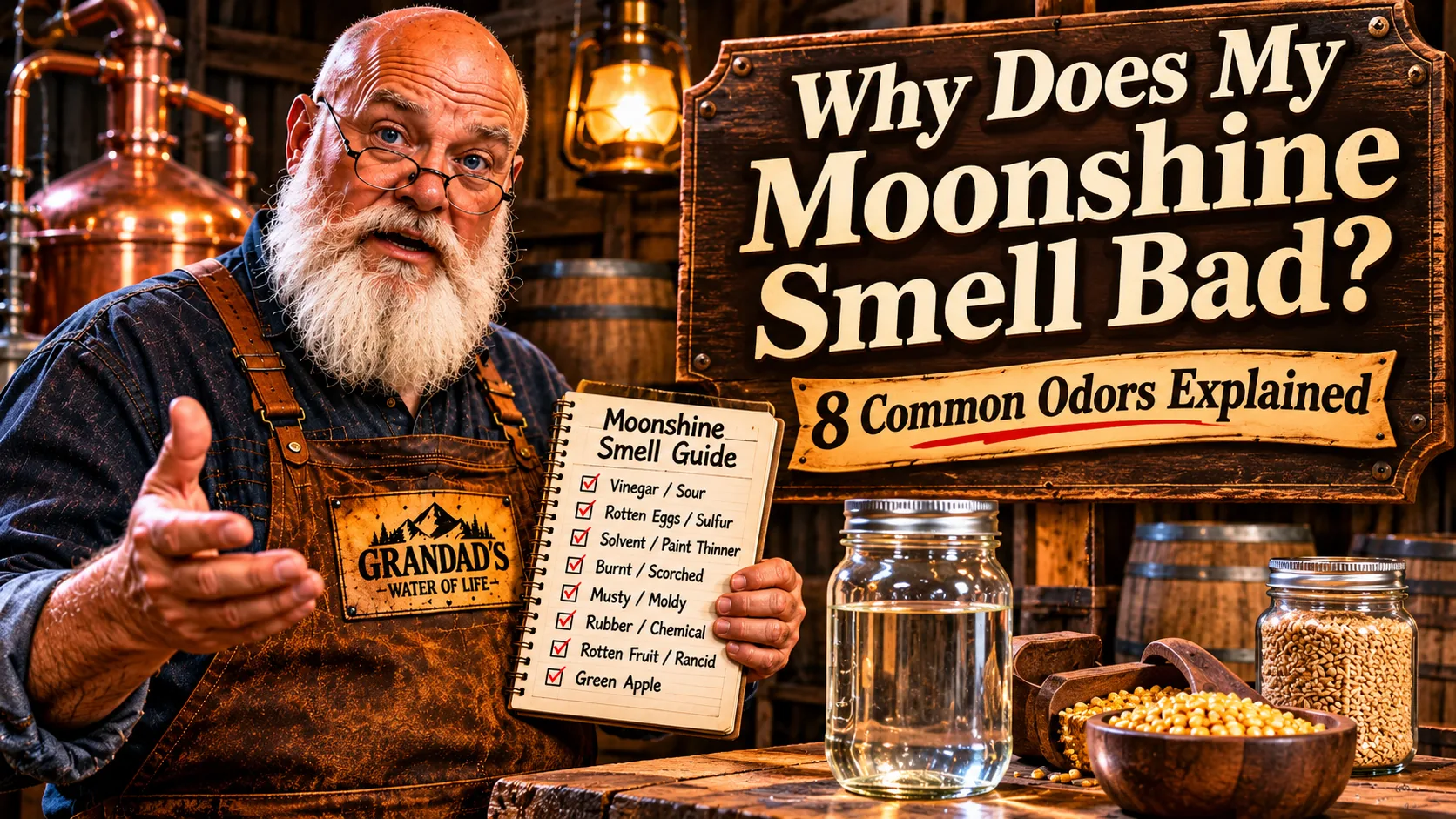
Why Does My Moonshine Smell Bad?
8 real odor problems beginners may encounter—and what they might mean.
Vinegar? Rotten eggs? Something like nail polish remover? Grandad’s smell guide helps you understand possible causes, distinguish mash aromas from finished-spirit problems, and recognize when a batch should not be consumed.
⚡ Grandad’s Quick Answer
Why does my moonshine smell bad? Unpleasant odors can come from fermentation byproducts, unwanted microbial activity, scorched ingredients, unsuitable equipment materials, or storage contamination. The likely explanation depends on what the smell resembles and whether it comes from fermenting mash or the finished spirit.
Start here: Use the odor finder below as an educational reference. Do not repeatedly sniff or taste an unfamiliar product to identify it, and do not assume an odor proves which chemical is present.
Safety First: A Smell Is Not a Safety Test
Odor descriptions cannot reliably identify methanol, isopropyl alcohol, or other contaminants. A spirit that smells normal may still be unsafe. If the source, ingredients, equipment, or safety of a batch are uncertain, do not consume it. Filtering, sweetening, dilution, or masking an odor does not establish safety.
8 Moonshine Odors Worth Investigating
When someone asks why does my moonshine smell bad, the answer often depends on the stage and ingredients. These are recognized off-odor descriptions that can arise in fermented beverages or spirits. Their significance depends on the product and circumstances. Some aromas may be expected at low levels in fermentation; unexpected, strong, or persistent odors deserve closer attention.
1 Vinegar or Sharp Sourness
A distinct vinegar-like odor can be associated with acetic acid, which may develop when certain microorganisms act on alcohol in the presence of oxygen. Not every sour aroma means the same thing: fermentation can also produce other organic acids.
What to investigate: Whether the smell began during fermentation or appeared later, and whether there is documented oxygen exposure, spoilage, or a change in storage conditions.
2 Rotten Eggs or Sulfur
A rotten-egg smell is commonly associated with hydrogen sulfide, a sulfur-containing compound that yeast can produce under some fermentation conditions. Other sulfur compounds can contribute onion-like, cabbage-like, or rubbery notes.
What to investigate: Fermentation records, ingredient quality, and whether the odor is limited to active fermentation or remains in the finished product.
Safety note: Do not deliberately inhale concentrated fermentation gases or enter poorly ventilated fermentation spaces.
3 Nail Polish Remover, Paint Thinner, or Solvent
Some fermentation-related volatile compounds, including ethyl acetate, can produce a solvent-like impression. Ethanol vapor itself may also smell sharp. Similar-smelling substances cannot be reliably distinguished by nose alone.
What to investigate: The product’s documented source, fermentation history, ingredients, and storage materials. Never assume the odor identifies isopropyl alcohol or methanol.
4 Burnt, Smoky, or Scorched
A harsh burnt odor can be associated with scorched grain or other heated ingredients, smoke exposure, or residues affecting equipment. Deliberately smoky spirits also exist, so context matters.
What to investigate: Whether the smell was intentional, whether ingredients or equipment showed signs of scorching, and whether the odor appeared suddenly.
Do not assume: That filtering will remove every substance responsible for an unexpected burnt or chemical odor.
5 Musty, Moldy, or Damp-Basement
Musty smells may be linked to mold-affected ingredients, contaminated storage areas, or microbial spoilage. Some compounds responsible for musty aromas can persist even when visible mold is absent.
What to investigate: Ingredient condition, storage history, visible contamination, and whether containers were intended for food or beverage contact.
6 Rubber, Plastic, or Chemical
Unexpected rubber or plastic-like odors can be associated with unsuitable contact materials, degraded seals or tubing, cleaning residues, or certain sulfur compounds. The smell alone cannot tell you which explanation applies.
What to investigate: The documented compatibility of every material that contacted the liquid, including gaskets, tubing, lids, and containers.
Safety note: Do not drink a product if contamination from unknown or non-food-safe materials is suspected.
7 Rotten Fruit, Rancid Butter, or Cheesy Odors
Some undesirable fermentation aromas are associated with volatile fatty acids, including butyric acid, or with microbial activity and spoiled ingredients. The descriptions vary: people may call them cheesy, rancid, sweaty, or like decaying fruit.
What to investigate: Ingredient freshness, fermentation records, and whether there were signs of spoilage or unexpected changes.
Important: These descriptions are subjective; no single smell establishes a particular organism or compound.
8 Strong Green Apple or Sharp Fruity Odor
A pronounced green-apple note is often associated with acetaldehyde, a compound involved in alcohol fermentation. Fruity aromas can also come from esters and ingredients, and are not automatically defects.
What to investigate: Whether the aroma is normal for the ingredients and style, unusually intense, or part of a broader change in the product.
Understand the Craft, Not Just the Symptoms
Grandad’s Water of Life brings together whiskey history, traditional methods, essential terminology, and illustrated beginner-friendly references.
Explore the Book →Know the Rules Before You Begin
In the United States, beverage-spirit production is regulated. For official federal information, see the Alcohol and Tobacco Tax and Trade Bureau’s distilled spirits guidance. This legal reference does not establish that any particular batch is safe.
Grandad’s Safety-First Smell Checklist
If you are wondering why does my moonshine smell bad, use known facts about a batch rather than tasting or repeatedly sniffing it.
- Identify the stage. Is the odor coming from fermenting mash, the equipment, or finished spirit?
- Confirm the source. Is the product’s origin and ingredient history known and documented?
- Review changes. Did the odor appear during fermentation, after processing, or after storage?
- Check contact materials. Were all containers, seals, and components suitable for beverage contact?
- Look for contamination evidence. Consider ingredient spoilage, unsuitable storage, residues, or unexpected changes.
- Do not use taste as proof. Neither a pleasant aroma nor a small sip establishes safety.
- When uncertain, don’t consume it. Seek qualified guidance or appropriate testing rather than trying to mask the smell.
Frequently Asked Questions
Why does my moonshine smell bad?
Possible explanations include fermentation byproducts, microbial activity, scorched ingredients, contact with unsuitable materials, or storage contamination. The smell and the stage where it appeared provide context but cannot prove the cause.
Is a vinegar smell in moonshine normal?
Some acidity is part of fermentation, but a strong vinegar-like odor can indicate acetic acid formation or other changes. Its meaning depends on whether it comes from the mash or finished spirit and on the product’s documented history.
Why does fermenting mash smell like rotten eggs?
Yeast can produce hydrogen sulfide under certain fermentation conditions. Rotten-egg odor may also have other sulfur-related explanations. Avoid inhaling fermentation gases and don’t assume the finished product is safe based on smell.
Does a rubbing-alcohol smell mean moonshine contains isopropyl alcohol?
No. Several substances can smell sharp or solvent-like. Smell alone cannot identify isopropyl alcohol or rule out hazardous contamination. See Problem #5 for more information.
Can I fix a bad smell by filtering or adding flavor?
Filtering or flavoring may change perceived odor, but neither establishes that an unknown or contaminated spirit is safe to consume. Do not use masking as a safety remedy.
Can I tell whether moonshine contains methanol by smelling it?
No. Methanol cannot be reliably identified or excluded by smell or taste. Product safety depends on verified sourcing, proper controls, and appropriate testing where needed.
Does a normal smell mean moonshine is safe?
No. Harmful contamination may not produce a distinctive odor. A normal smell is not proof of safety.
Educational and legal notice: This guide discusses possible odor explanations and safety concerns. It does not certify a product as safe or provide a substitute for laboratory analysis or qualified professional advice. In the United States, producing distilled spirits for beverage use generally requires federal authorization, and state and local rules may also apply. Learn the applicable law before engaging in any activity.