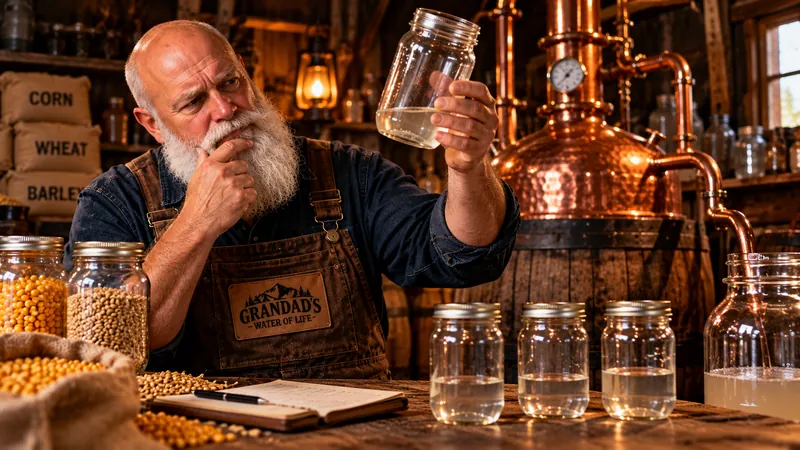
Why Have I Got a Lower Yield?
Why is my moonshine yield so low? Seven reasons—and how to find the real cause.
Expected more from your batch and ended up scratching your head? Before you blame the still, let’s find out whether the problem started in the mash—or whether the numbers are fooling you.
⚡ Grandad’s Quick Answer
Low moonshine yield often comes from incomplete fermentation, too little fermentable sugar, unrealistic expectations, or inaccurate measurements.
Start here: Check whether fermentation finished, then compare alcohol content—not just the number of jars—with what you expected.
Grandad’s rule: diagnose first, change things second. A low yield is a symptom, not a diagnosis. The seven checks below help you work out what happened and what to improve on a future lawful batch.
Jump to the answer you need
Is your yield really low? 1. Fermentation stopped early 2. Not enough fermentable sugar 3. Yeast was stressed 4. Expectations were too high 5. Proof and volume were confused 6. Measurements were inaccurate 7. Alcohol wasn’t all recovered Frequently asked questionsFirst: Is Your Yield Actually Low?
Wondering why is my moonshine yield so low when the jars look half-empty? First compare alcohol concentration as well as liquid volume. A smaller amount at a higher ABV can contain the same quantity of alcohol as a larger amount at a lower ABV.
Grandad’s quick comparison: One gallon at 40% ABV and half a gallon at 80% ABV each contain about 0.40 gallon of pure alcohol. Compare alcohol content, not just jar count. These figures illustrate the math—not drinking strengths or collection targets.
If you don’t know the starting gravity, final gravity, or actual ABV, you may not have enough information to determine exactly where the shortfall occurred. That’s okay—use the symptoms below to narrow it down.
Fermentation Stopped Before It Finished
Yeast may have left fermentable sugars behind, reducing the amount of alcohol produced before any distillation began.
Check gravity over time
Take sanitized hydrometer samples and compare specific gravity readings 24–48 hours apart. A falling reading means fermentation is continuing. A stable reading means it has stopped changing—not necessarily that all available sugar was consumed.
Find out why it stopped
Review the yeast’s recommended temperature range, original gravity, sanitation, and whether the mash contained fermentable sugars. Don’t assume more yeast or more sugar is the automatic fix.
For a full diagnosis, see Problem #2: Mash Not Fermenting?
There Was Less Fermentable Sugar Than You Thought
Grain starch is not automatically fermentable sugar. If starch conversion was incomplete—or a recipe assumed more fermentable material than was available—the batch’s potential alcohol may have been lower from the start.
Review the starting gravity
Look for a starting gravity reading taken before fermentation. Compare it with the recipe’s expected range and check whether the recipe was designed for your ingredients.
Use measurements, not guesses
For future legal fermentation projects, use a tested recipe, follow its starch-conversion instructions where applicable, and record starting gravity. Avoid adding ingredients blindly after fermentation.
The Yeast Was Stressed
Yeast performs poorly when conditions are unsuitable. Temperature extremes, insufficient nutrients, unsuitable pH, or excessive starting sugar can all contribute to sluggish or incomplete fermentation.
Check the fermentation conditions
Review temperature records, yeast strain guidance, gravity changes, and signs of contamination. Airlock bubbles alone cannot confirm yeast health.
Match conditions to the yeast
Use a suitable yeast and follow the manufacturer’s temperature and nutrient guidance for lawful fermentation. Sanitize equipment and avoid large temperature swings.
Understand Your Mash, Not Just the Bubbles
Grandad’s Water of Life brings together whiskey history, essential terminology, fermentation fundamentals, and illustrated field references in one beginner-friendly guide.
EXPLORE THE BOOK →Your Expected Yield Was Too High
Online yield claims sometimes leave out assumptions about fermentable sugar, fermentation efficiency, alcohol concentration, and what is actually collected. A number from someone else’s batch is not a reliable prediction for yours.
Find the original assumption
Was your expectation based on a recipe, a social-media comment, or a measurement? Check whether the claimed yield specifies both liquid volume and ABV.
Compare like with like
Use consistent units, documented gravity readings, and ABV measurements. Treat online yield figures as estimates unless their assumptions are explained.
You Mixed Up Proof, ABV, and Volume
Proof and ABV describe alcohol concentration; gallons or liters describe volume. They answer different questions. In the United States, proof is twice the ABV percentage—for example, 80 proof is 40% ABV.
Look at both numbers
Write down the volume and measured ABV of each sample. Don’t compare two batches solely by how many jars they filled.
Keep a consistent record
Record volume, ABV, and measurement temperature together. Use an appropriate calibrated instrument and its temperature correction instructions.
Your Measurements Were Off
A brewing hydrometer measures liquid density and is useful for tracking fermentation. An alcoholmeter is a different instrument used for appropriate distilled spirit mixtures. Confusing the two can create wildly misleading numbers.
Check the instrument
Confirm whether you used a brewing hydrometer, refractometer, or alcoholmeter. Check calibration, temperature correction, and whether sugar or other dissolved ingredients affect the reading.
Use the right method
Follow the instrument’s instructions and note the measurement temperature. A refractometer reading after fermentation needs an appropriate alcohol correction; an alcoholmeter is not reliable for sweetened or flavored spirits without a suitable method.
Not All Alcohol Was Recovered or Counted
Even when fermentation has produced alcohol, the final amount of collected spirit depends on the process, retained liquid, and what is excluded from collection. Those differences can make the final volume look smaller than an optimistic estimate.
Review your records
Check whether your estimate assumed all alcohol would be recovered. Compare recorded quantities and concentrations without treating the largest possible collection volume as a safety goal.
Put safety before yield
Never bypass safety practices or include questionable material just to increase output. Distillation equipment and procedures require appropriate legal authorization, training, and fire-safety controls.
🥃 Grandad Says
“If the jars don’t add up, don’t start guessing. Check what went into the mash, what the yeast actually did, and what your measurements really mean. Good notes beat a good story every time.”
Grandad’s 60-Second Low-Yield Checklist
- Starting gravity recorded? If not, the original alcohol potential is uncertain.
- Final gravity recorded? If not, you cannot reliably assess how far fermentation progressed.
- Gravity stable? If yes, fermentation may have stopped; investigate whether it finished as expected.
- Temperature and yeast appropriate? If not, yeast stress is a plausible contributor.
- Expected and actual ABV known? If not, jar volume alone cannot establish alcohol yield.
- Instrument and corrections verified? If not, repeat measurements using the correct method.
Frequently Asked Questions
Why is my moonshine yield so low?
Common explanations include incomplete fermentation, lower-than-expected fermentable sugar, unrealistic estimates, or errors comparing volume and ABV. Start by checking gravity records and the assumptions behind your expected yield.
Does a quiet airlock mean I lost alcohol yield?
No. A quiet airlock is not proof that fermentation stopped. A hydrometer reading taken over time is a better way to track changes in fermentation.
Can a mash finish fermenting and still have a low yield?
Yes. A batch can finish fermenting but contain less alcohol than expected if it started with less fermentable sugar, or if the expected yield was unrealistic.
Is a smaller volume always a lower alcohol yield?
No. Alcohol concentration matters. A smaller volume at a higher ABV can contain the same amount of alcohol as a larger volume at a lower ABV.
Can I calculate exact alcohol yield from jar count?
No. You need reliable volume and alcohol concentration measurements. For fermentation potential, original and final gravity readings are also useful, though they provide estimates rather than perfect measurements.